Last updated: January 5, 2026 · 12min read
AI for Fraud Detection: How it Works and Why It Matters


The European Banking Authority reported that payment fraud rose to €4.2 billion in losses in 2024, up from €3.5 billion the previous year.1 Meanwhile, data from the Global Anti-Scams Alliance (GASA) 2025 report finds consumers worldwide lost $442 billion to scams in 2024. At a time when significant fraud and scams threaten consumers’ and businesses’ trust and finances, artificial intelligence (AI) is the most crucial asset in financial institutions’ toolbox for modern fraud detection.
Unlike legacy rules-based systems alone, AI and machine learning can rapidly analyze mountains of data to uncover new fraud trends before they cause significant damage. While rules can help trigger immediate responses when risk-based thresholds are reached, they require manual adjustments and are often outmaneuvered by fraudsters. In other words, while they still play an essential role, rules alone are not enough to tackle modern fraud threats.
As fraud becomes increasingly aggressive and innovative, businesses need to keep pace with bad actors’ speed and scale. In this article, we’ll explore how AI for fraud detection works in practice, how it helps financial institutions stay ahead of emerging fraud threats, and the key trends to monitor.
Key Takeaways
- AI uses predictive analytics and machine learning algorithms to review large volumes of data and identify suspicious patterns rapidly.
- As fraud grows increasingly sophisticated, the AI fraud detection market is poised to grow to $39.1 billion by 2030, according to Juniper Research.2
- AI empowers organizations to uncover more fraud accurately, reduce costly false positives, reach real-time risk assessments, and minimize fraud losses.
- Implementing AI-powered fraud detection solutions will be vital as criminals increasingly use powerful methods such as deepfakes and synthetic identity fraud.
What is AI for Fraud Detection and How Does It Work?
In fraud detection, AI uses predictive analytics and machine learning algorithms to analyze large quantities of data in real time to uncover suspicious patterns. By evaluating transaction data, behavioral activity, and network relationships, financial institutions and businesses can identify unusual or troubling patterns that would otherwise go undetected by human eyes alone.
The AI Advantage: Fraud Fighters’ New Career Guide
Research from Feedzai finds AI is an essential career differentiator for fraud fighters, enabling them to excel in their current positions and unlock greater advancement and higher earning potential.
As fraud grows more sophisticated and aggressive, the AI for fraud detection market is expanding. Data from Juniper Research projects that financial institutions worldwide will spend $39.1 billion on fraud detection by 2030.2
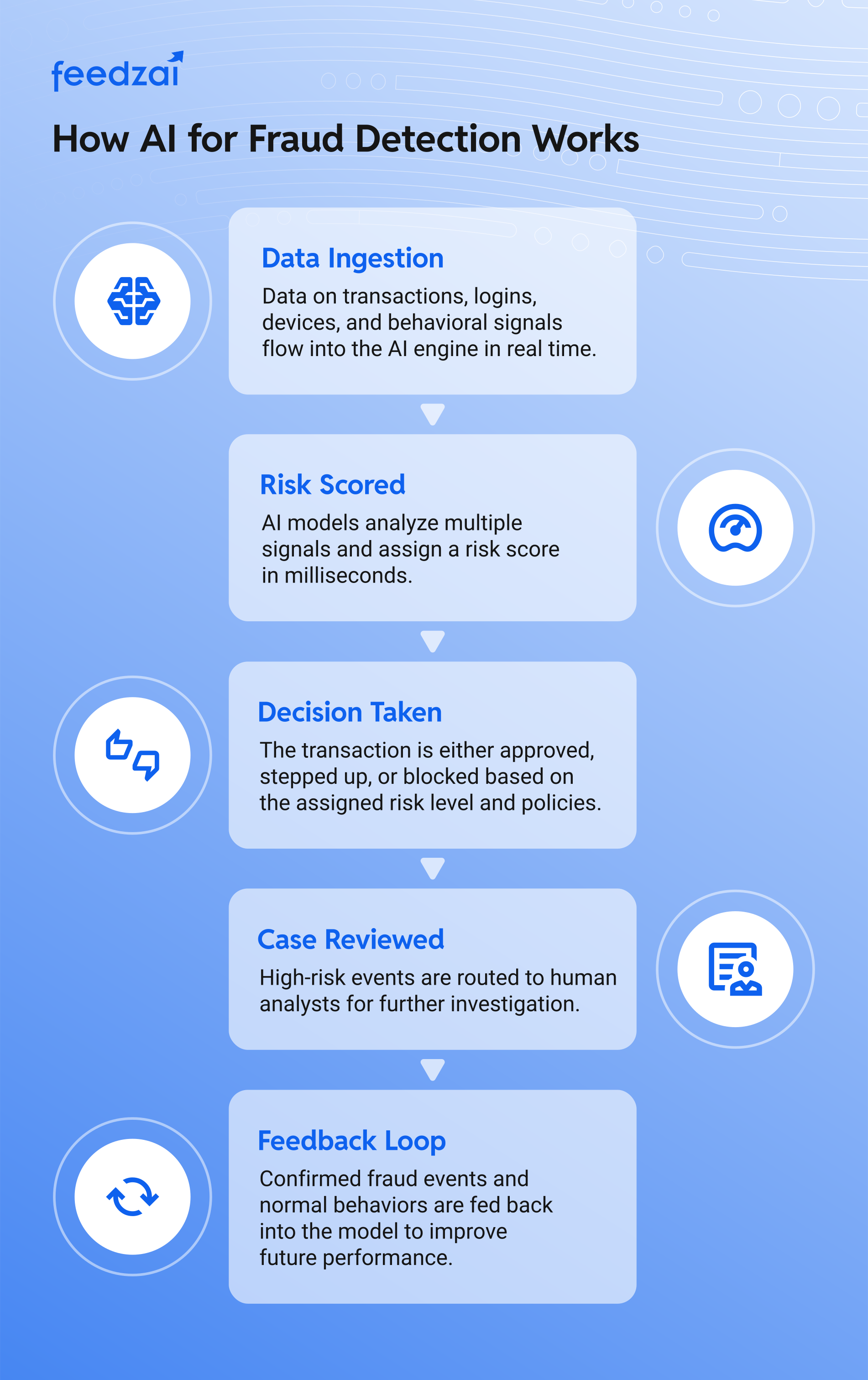
AI for fraud detection includes three core stages:
1. Real-Time Data Analysis
Models ingest large quantities of data in milliseconds to generate a risk score. The technology considers a wide range of attributes, including:
- Payment types: the channel or payment method used to make a purchase or transaction (e.g., payment card, ACH, digital wallet).
- Logins: how, when, and from where a user signs into their account.
- Device IDs: identify whether a device is recognized or a new one.
- Profile updates: track changes to sensitive details on an account (e.g., password, email addresses, home addresses).
Additionally, the technology considers essential payment data, including:
- Transaction values: the amount being moved or exchanged in a transaction.
- Merchant category: type of business being paid, to gauge its risk level.
- Geolocation: where a transaction or session originates to detect unusual changes in location over an unusual period of time.
- Device fingerprints: measures technological attributes of a unique device across sessions (e.g., browser, OS, hardware).
- Session context: consider additional factors during a session (e.g., pages visited, actions taken) to inform behavioral context before transaction decisions.
- Behavioral signals: observe how a user interacts with and uses their device (e.g., typing, swiping, clicking, or navigation) to determine whether a legitimate user is behind a transaction or if a bot or fraudster has hijacked the session.
2. Pattern Recognition and Anomaly Detection
The systems establish a behavioral baseline for each customer, establishing a pattern of “normal” behavior. This data includes what the user typically spends, the devices they use, and their preferred method of interacting with their bank (e.g., web, mobile). Deviations from the user’s common patterns are flagged as potential anomalies.
3. Adaptive Learning and Decision-Making
Once deployed, AI systems do not remain static. They continuously learn after initial deployment. By perpetually gaining new insights and information, the systems grow more effective once confirmed fraud cases are labeled, allowing the technology to retrain itself to respond to new fraud patterns and threats. This ability is essential because scams and fraud are constantly changing. Current social engineering or deepfake fraud will inevitably change over time, requiring responsive systems that can keep pace.
Benefits of AI for Fraud Detection for Financial Institutions
The good news is that organizations do not have to fully replace rules-based systems with AI. Instead, they can supplement their existing systems with AI and machine learning, ultimately making them more effective in the fight against fraud.
Increased Accuracy
AI models can learn from vast, dynamic datasets to accurately pinpoint fraud signals with remarkable precision, enabling organizations to quickly identify complex fraud patterns and maintain security while protecting customers from fraud-related losses. The ability to rapidly detect fraud is essential to building a secure, scalable fraud strategy.
Fewer False Positives
False positives are far more serious than an operational headache. They can both hurt the customer experience and waste valuable company resources investigating them. AI can understand the nuanced patterns behind transactions that a standard rule would usually flag. By reducing false positives, your analysts can focus on more challenging, higher-value cases rather than pursuing false leads.
Real-time Risk Assessment at Scale
Speed is one of AI’s most impressive attributes in the fraud prevention space. AI can process billions of data points across multiple payment or banking channels, offering a real risk score for a transaction as it occurs. This is the difference between catching fraud before it harms a customer and determining that fraud occurred after losses occurred.
Reduced Fraud Losses
Fraud costs more than the money involved in a fake transaction. It also results in lost time, resources, and revenue due to investigations. Consider that improving fraud detection by as much as 1% can yield millions in savings.
Enhanced Customer Experience and Trust
Customers expect to complete their transactions as seamlessly as possible, without interruptions. Fraud prevention measures that interrupt customers from completing a purchase or a transaction can cause customer frustration and undermine trust, ruining efforts to build loyalty with your base. Advanced AI-powered fraud prevention systems include technologies such as behavioral biometrics that can passively analyze user behavior (e.g., typing speed, touchscreen pressure, or mouse movements) without causing unnecessary friction.
Improved Analyst Efficiency with GenAI
GenAI is becoming a critical tool for operations teams. Instead of analysts digging through large quantities of data, GenAI provides instant summaries and deeper insights, enabling faster, smarter decisions and turning complex fraud patterns into plain-spoken explanations. This rapid access to data-driven insights helps your team focus on stopping threats rather than deciphering spreadsheets.
Proactive Regulatory Compliance
Many regions worldwide, including the UK, the EU, Australia, and Singapore, have implemented “failure to prevent” regulations that establish liability frameworks designed to enhance customer protections. AI-powered fraud detection systems provide explainable decisions and audit trails, enabling organizations to prove how they are proactively protecting their customers.
Common AI Fraud Detection Challenges & How to Solve Them
While it’s essential to understand the key benefits of AI for fraud detection, it’s also critical to understand common obstacles. AI is a powerful tool, but it must be adopted with care. Understanding the key challenges and planning for them accordingly can ensure AI implementations go as smoothly as possible.
Data Quality and Fragmentation
Feedzai’s 2025 AI Trends in Fraud and Financial Crime report found that data quality is a top concern for banks as they start their AI projects. The report, which surveyed 562 financial services professionals worldwide, found 87% of respondents cite data management and accuracy as their top AI challenges. This is because some legacy systems operate in silos for different channels (e.g., card, mobile, online), which can produce fragmented or inconsistent data that builds a fragmented view of customer behaviors.
How to Solve: Before implementing AI, build a unified view of data that consolidates transaction history, customer profiles, and behavioral signals. Ensuring clean, accurate data is critical to building trustworthy AI models.
Legacy System Integration
The idea of replacing or swapping rules-based systems with AI can be overwhelming due to the cost and scope of such a project. Fortunately, it’s unnecessary. AI and machine learning models can supplement existing legacy rules-based systems without replacing them.
How to Solve: Deploy AI solutions alongside legacy systems using an API-driven architecture. Ensure your solutions integrate with monitoring tools, case management, and alert workflows. AI can enrich decisions without requiring a complete infrastructure replacement.
Regulatory Compliance and Explainability
Feedzai’s report found that many companies have only begun their AI initiatives in the past three years. As AI adoption expands, it’s crucial to understand how a model arrives at its decisions. This insight is critical for both the organization that owns and operates the technology and for regulators investigating decisions that impact customers’ livelihoods.
How to Solve: Ensure your models are trustworthy from the moment of development. Following the TRUST Framework, based on the pillars of Transparent, Robust, Unbiased, Secure, and Tested, offers a guide to implementing responsible AI principles from day one.
Key Fraud Detection Metrics: How to Measure Success With AI
You can’t fix what you don’t measure. With AI, it’s essential to ensure your deployment aligns with your organization’s key business objectives and can demonstrate value to stakeholders. Consider the following criteria when assessing your AI’s performance.
- True Positive Rate. This measures the percentage of real fraud that your system correctly identifies. The higher the rate, the better. However, be careful that your model’s rate isn’t too high. For example, a detection rate of 100% indicates the model is too aggressive.
- False Positive Rate. The percentage of legitimate transactions incorrectly flagged as fraudulent. A false positive rate of 5% means that one in 20 legitimate transactions is inaccurately blocked or flagged. Every percentage point in false positives reduced can yield millions in savings and saved time.
- Fraud Type Coverage. Different fraud types require different detection strategies. Your metrics should track how well the system performs across categories such as card-not-present fraud, account takeover fraud, synthetic ID fraud, new account fraud, scams, and money laundering.
- Detection Speed. Measure how quickly your system identifies fraud after a suspicious transaction is flagged. Real-time systems should flag suspicious activity in milliseconds, blocking suspected fraud faster and reducing potential damage.
- Value Detection Rate. It’s essential to be able to put a dollar figure on the cost associated with preventing attempted fraud. Track the actual dollar value of the losses you prevent to prioritize high-stakes threats that have the most significant impact on your bottom line.
Advanced AI Techniques: Behavioral Biometrics, Anomaly Detection & Graph AI
Advanced AI solutions don’t rely on a single technique. Instead, they contain multiple-layered approaches that can detect fraud activity that another layer might overlook. These layers include:
Behavioral Biometrics
Behavioral biometrics technology silently authenticates users’ interactions with their devices in the background. The technology considers how a user types on a keyboard, moves their mouse, or taps on a device screen. It also believes that if a user is hesitant or navigating between a mobile and web application, which are often red flags of a scam (e.g., romance scams, APP fraud).
Anomaly Detection
Anomaly detection algorithms detect when a user’s behavior significantly deviates from normal patterns. These approaches include:
- Statistical Measures. These models assess whether a data point (e.g., a transaction amount or time) falls outside the user’s regular routine.
- Isolation Forest. This approach breaks down data into smaller subsets by selecting random partitions and features. This helps identify outliers within a user’s local peer group rather than the general population.
- Local Outlier Factors (LOF). The LOF approach compares the density of a data point to its neighbors, flagging points with significantly lower density as outliers.
- Autoencoders. Autoencoders are neural networks capable of reconstructing input data. This approach is powerful for complex, high-dimensional data and can detect subtle, multi-variable anomalies that simpler statistical methods miss.
Graph AI
Fraud does not happen in a vacuum. It’s an event spread across multiple entities and devices. Graph AI blends AI with graph technology to highlight connections between entities, making it easier to identify the parties involved in a fraud and their relationships. By using Graph AI, events that might appear unimportant in isolation are revealed as high-risk or integral to fraud and scam activity.
AI Fraud Detection in 2026: New Threats, Deepfakes & Fraudster AI Tools
AI will be a core component for fraud teams as they face a new wave of sophisticated threats in 2026 and beyond. Fraud attacks are becoming industrialized, allowing bad actors to launch different methods at scale. Explore some of the most troubling fraud types to understand why AI is mission-critical for fraud detection.
“Not only are criminals rapidly inventing new AI-powered frauds, but they’re also making familiar ones even more effective.” — Dan Holmes, Vice President, Global Product Planning & Strategy, Feedzai
Deepfake Attacks
Deepfake fraud has moved from novelty concepts to common tools for bad actors to launch fraud and scam efforts. This technology has advanced to the point where it can create persuasive voice and video clones of real people. Bad actors can use deepfakes to bypass real-time identity verification procedures or social engineer transactions by mimicking a user’s voice. It’s essential to ensure your AI understands the context behind a transaction rather than matching names, faces, or voices to a document.
Fraud-as-a-Service
Advanced fraud toolkits are now freely available as turnkey services among criminal networks, often including phishing kits, pre-programmed malicious bots, or AI-written prompts for different types of scams. Armed with these abilities, fraudsters can launch attacks at incredible speed and scale. It’s essential that AI solutions can quickly assess context rather than rely on static indicators.
Synthetic ID Fraud
Criminals are using synthetic ID fraud (supported by deepfakes and GenAI fraud technology) to craft convincing profiles and open accounts using a combination of real and fabricated customer information. Once they breach an account, they can bide their time and build credit or recruit money mules.
How to Implement AI for Fraud Detection
The pivot from legacy rules to AI isn’t a sprint. It’s an evolution. Remember, you’re not reinventing the wheel; you’re building a smarter engine. Here’s how to strategically integrate AI to stay ahead of new and existing fraud threats.
Establish a Baseline and Priorities
You wouldn’t travel to an unknown location without a map or a guide. The same should be true for your AI implementation plans. Before you invest in AI, understand the pain points you want to address, whether it’s reducing false positives, quickening onboarding, or improving revenues by minimizing fraud losses. Whatever your goals are, set clear benchmarks for success.
Build a Unified Data Foundation
Remember that AI and its outputs are only as good as the data that supports it. Make sure your data is top-quality and avoid fragmented operations. Ensure your models have a consolidated view of transaction history and behavioral signals, giving them a single view of activity rather than separate pieces of a puzzle.
Layer AI into Existing Data Flows
Don’t get overwhelmed by data. Use AI to find the key insights amid the noise. Add AI directly into your existing infrastructure to enrich its decisions, without completely overhauling or replacing your legacy systems.
Employ Multiple Analytical Techniques
Fraud isn’t a single event. Your approach to fraud detection and prevention can’t be single-focused, either. Feedzai uses a layered approach to fraud detection that combines behavioral biometrics, malware detection, and device and network intelligence to uncover connections between multiple entities and catch fraud patterns.
Close the Feedback Loop
Keep your AI and machine learning models up to date by incorporating key learnings. Label known or confirmed fraud cases to retrain your models to catch new patterns. Building a feedback loop will ensure your defenses get stronger with every transaction.
Ensure Trustworthiness
While AI is a critical part of fraud detection, its decisions can’t be the default factor. Ensure you and your team understand how AI models reached their conclusions. Use guidance such as Feedzai’s TRUST Framework to ensure models are trustworthy and that audit trails are easily accessible to regulators.
The goal of AI for fraud detection isn’t just to block bad actors. It’s to unlock safe, scalable growth for your organization. By moving from reactive rules to proactive, real-time insights, financial institutions can protect their bottom line while building deeper trust with their customers. The future of fraud is fast, but with the right AI strategy, you’re faster.
FAQs About AI for Fraud Detection
What is AI for fraud detection?
AI fraud detection uses machine learning and predictive analytics to spot suspicious activity. Unlike manual rules-based systems, AI analyzes massive datasets in milliseconds to find hidden patterns in transactions and behaviors. Significantly, the technology is constantly evolving to identify threats before they can inflict financial or reputational damage.
How does AI detect fraud?
AI identifies fraud through three core stages: real-time data analysis, pattern recognition, and adaptive learning. It establishes a “normal” behavioral baseline for every customer, tracking their spending and where they log in. When a transaction deviates from these familiar patterns, the system flags it as a potential anomaly for immediate investigation.
Is AI better than rule-based fraud detection?
Rules are great for fixed thresholds, but they are easily outmaneuvered if fraudsters learn their thresholds. AI has the advantage because it’s dynamic, it understands nuances in activity (e.g., why an early-morning purchase is normal for one person but risky for another). It can supplement existing rules rather than replace them, making the entire system more accurate and scalable.
What are false positives and how to reduce them?
False positives occur when legitimate transactions are incorrectly flagged as fraudulent, leading to customer frustration and wasted resources. AI reduces these “false alarms” by analyzing the context behind a purchase rather than just following rigid formulas. This allows your analysts to focus on high-value, complex cases instead of chasing down innocent customers.
Can AI keep up with new fraud tactics like AI-generated receipts or deepfakes?
As fraud becomes industrialized with deepfakes and automated toolkits, static indicators are no longer enough. AI stays ahead by analyzing behavioral context (e.g., how a user interacts with their device) rather than just matching names or faces. This adaptability is essential for tackling the sophisticated “fraud-as-a-service” attacks.
Footnotes
All expertise and insights are from human Feedzaians, but we may leverage AI to enhance phrasing or efficiency. Welcome to the future.